Context
Freight Delivery Network (FDN) was born as a sister platform to Deliver My Container, sharing a vision of eventually converging into a single end-to-end logistics solution where DMC handles international sea freight and FDN handles UK domestic land freight. Building on the same core architecture, the objective for version 1 was to adapt the existing DMC engine for a high-velocity domestic environment where shippers need to list multiple loads quickly and accurately. Rather than rebuilding from scratch, the challenge was to reinvent the interface layer making a familiar backend feel like an entirely different, faster product.
The Problem: The Velocity Gap
Domestic land freight moves at a much higher tempo than international shipping.
- The Friction of Detail: Shippers often felt "weighed down" by complex forms, leading to high drop-off rates or "dirty data" (selecting the wrong vehicle type just to finish the form faster).
- The "Mundane" Barrier: Standard logistics tools are notoriously dry. This leads to user disengagement and errors during repetitive data entry tasks.
My Role: UX Architecture & Visual Design
I was tasked with re-engineering the listing experience to prioritise Speed and Recognition.
- Streamlined IA: I audited the mandatory data points and used Progressive Disclosure to ensure users only saw fields relevant to their specific load, keeping the cognitive load low.
- Visual Taxonomy: By utilising High-Fidelity Isometric Assets, we bypassed the linguistic ambiguity of vehicle naming conventions, allowing for 'Pattern Recognition' which is significantly faster than 'Textual Processing' in high-stress environments.
Business & Technical Constraints
- Market Entry Velocity: As a V1 launch, the priority was to get a high-fidelity desktop experience into the hands of industry partners as quickly as possible.
- Backend Consistency: The flow had to leverage the existing DMC architecture. I couldn't reinvent the database; I had to reinvent the interface layer to make it feel faster.
- Adaptive Foundation: While the initial rollout was focused on desktop/tablet for office-based shippers, the design system needed to be modular enough to eventually support a mobile-responsive roadmap.
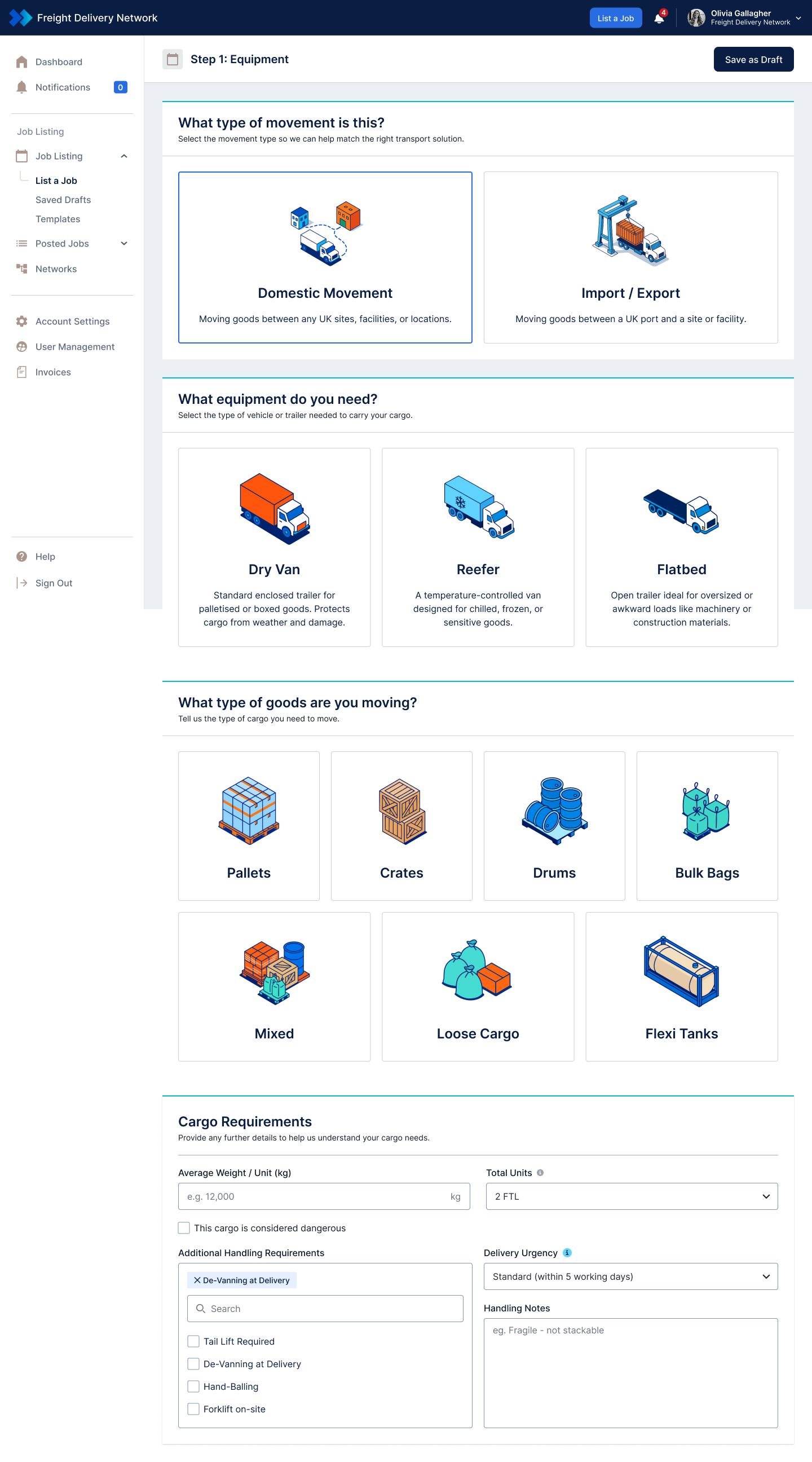
Design of the first step of the list of job flow
The High-Fidelity Isometric Assets eliminate linguistic ambiguity and speed up the "selection-to-action" loop. Visual recognition over terminology reduces errors from newcomers unfamiliar with freight naming conventions.
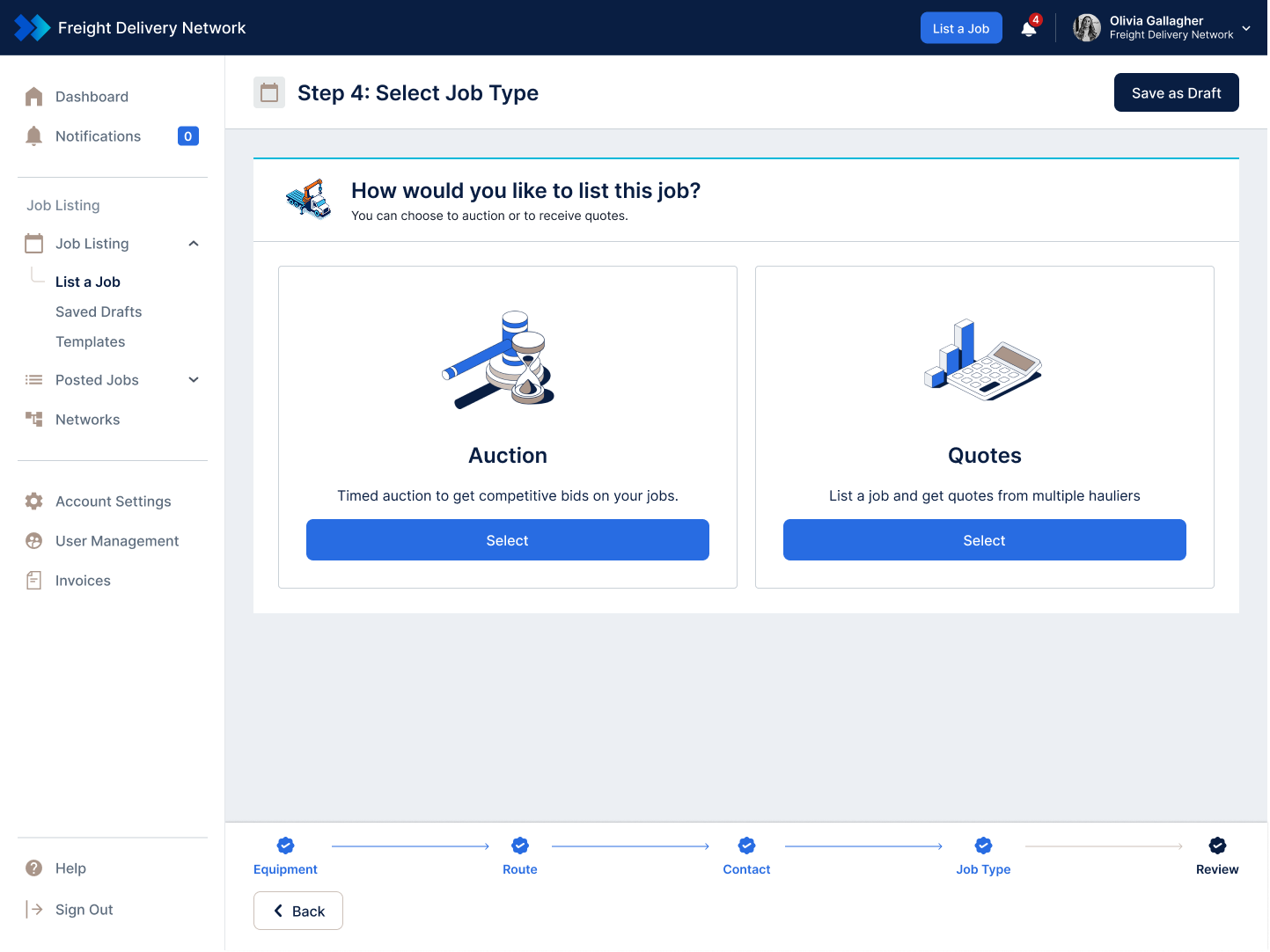
Design of the fourth step of the list of job flow
At this section we ask for the user to choose between Auction vs. Fixed Price changes the entire marketplace behaviour.
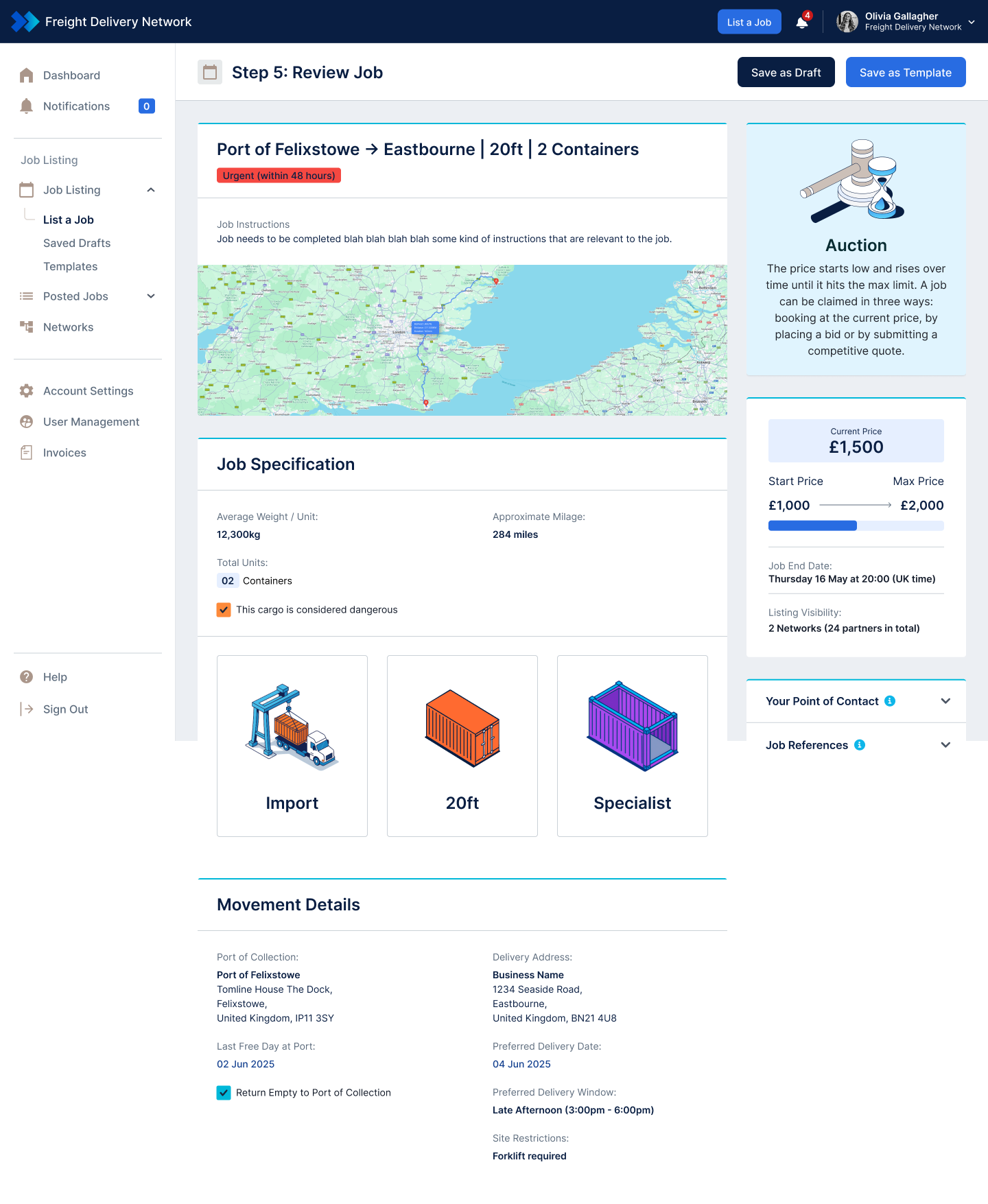
Design of the fifth step of the list of job flow
The final review isn't just a summary; it's a safety net. We summarise complex data into a scannable "Receipt" to prevent costly errors.
The Strategic Shift: Designing for the Power User
The core shift was moving from a Discovery-based flow to a Transaction-based flow.
- Transaction-First Architecture: Redesigned the listing flow as a tool rather than a form, stripping back any Discovery-based friction and treating every step as a direct transaction input.
- Progressive Disclosure: Audited all mandatory data points and restructured the flow so users only ever saw fields relevant to their specific load type, keeping cognitive load consistently low.
- Visual Recognition Over Terminology: Replaced text-based vehicle and equipment selection with high-fidelity isometric assets, eliminating the linguistic ambiguity of freight naming conventions. This significantly reduced errors from newcomers unfamiliar with industry terminology, allowing pattern recognition to replace textual processing.
- Step-Based Structure: Breaking the listing process into clearly defined sequential steps reduced the perceived complexity of the task, encouraging completion over abandonment.
Outcome
FDN remains in its early stages, operating as a sister platform to DMC with a shared pool of early adopters beginning to transition between both products. The long-term vision is a unified platform where sea and land freight are managed under one roof, FDN serving as the domestic land freight layer that completes the end-to-end supply chain story DMC began. The V1 launch successfully validated that the core DMC engine could be adapted for the higher velocity demands of domestic freight, and the visual selection system proved internally that a more human interface leads to faster, more accurate data entry. The next phase of growth is tied directly to the platform's eventual convergence.